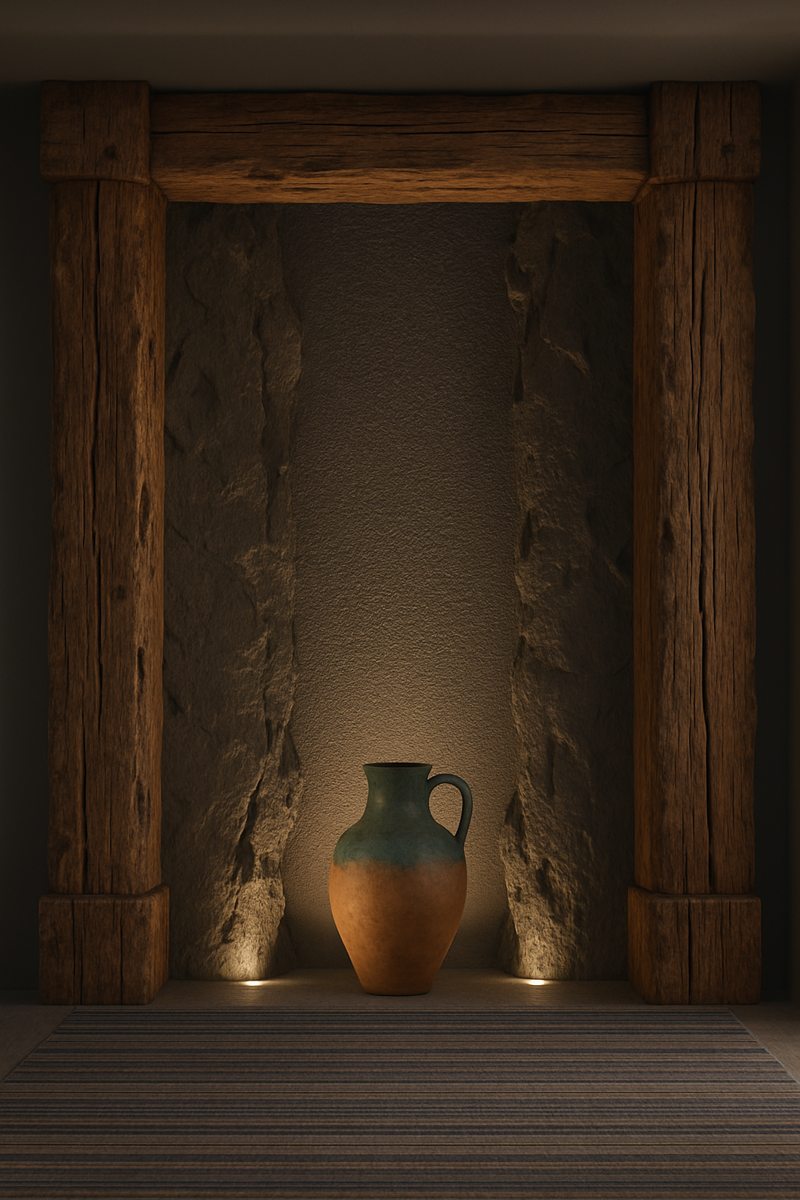
Decorative Coating Selection in Kitchens and Wet Areas
Discover how rigid polyurethane profiles perform in moist environments like kitchens and wet areas, covering density, thermal limits, and installation rules.
Material Characteristics and Moisture Performance
Rigid polyurethane profiles are manufactured as closed-cell architectural moldings featuring a density range of 150-220 kg/m³ (obiettivo ~160 kg/m³) and a water absorption rate under 1%. Unlike wood or MDF alternatives, high-density polyurethane does not absorb ambient vapor, swell, rot, or foster mold growth when exposed to continuous indoor humidity. However, decorative polyurethane profiles are not waterproofing insulation materials. While the material itself does not absorb water, it must never be installed on surfaces directly under continuous water submersions, such as the interior of shower trays or swimming pools.
Kitchen Applications and Thermal Service Limits
In kitchen interiors, wall paneling and crown moldings must endure cooking steam, grease accumulation, and frequent surface cleaning. Closed-cell polyurethane maintains physical integrity within a operational service temperature range of -100 °C / +80 °C. When installing decorative profiles near cooktops, stoves, or range hoods, profiles must remain outside the direct flame clearance zone to prevent exceeding the upper service limit of +80 °C. Surface maintenance should be carried out using standard, non-abrasive cleaning chemicals to maintain surface coatings without degrading the material.
European Technical Compliance and Factory Surface Preparation
Architectural projects across European markets require strict compliance with material transport and site handling standards. Polure manufactures polyurethane elements delivered with a factory-applied primer to protect the closed-cell surface during multi-country logistics and handling. While factory-primed surfaces provide an initial protective layer, declaring that no jobsite primer is needed is inaccurate; applying an additional site-specific primer remains an optional step based on the chosen final paint chemistry. Substrates must be completely clean and dry before mounting.
Adhesive Protocols and Mechanical Fastening in Damp Zones
Installing decorative moldings in wet areas requires strict adherence to mechanical and adhesive bonding protocols to handle structural vibration and humidity fluctuations. Profile joint connections require a precise 45-degree miter cut. Bonding must be executed using a dedicated polyurethane adhesive along all contact edges; the use of silicone adhesive is strictly forbidden due to inadequate long-term shear strength. Mechanical fixing using stainless steel screws is mandatory, followed by surface filling, sanding with grana 180-220 sandpaper, priming, and applying 2 coats of compatible topcoat paint.
Structural Restrictions of Decorative Columns and Exterior Rules
Decorative columns, pilasters, and half-columns produced from rigid polyurethane serve purely aesthetic functions and carry zero structural load. In open-plan kitchen designs or bathroom partitions, all structural weight must be supported by steel or masonry cores. Polure decorative covers must never be calculated as load-bearing supports. Furthermore, if decorative profiles extend to semi-outdoor or exterior transition zones, coating the pre-primed profiles with UV-resistant exterior paint is mandatory to prevent solar degradation over time.