


Architectural Depth and Structure in Wall Design
In modern and classical European architecture, creating focal points on flat walls is a fundamental design challenge. Premium decorative elements such as Duvar aplikler ve nişler (wall appliques and niches) offer an elegant structural solution. These architectural components break the monotony of plain vertical surfaces, adding depth, shadow play, and a curated gallery aesthetic to high-end residential and commercial projects. Manufactured from high-density rigid polymer with a density of 150-220 kg/m³, these elements achieve a hardness comparable to wood while remaining remarkably lightweight, making them highly favored by interior designers and architects across Europe.
Technical Specifications of Rigid PU Architectural Elements
The engineering behind these decorative moldings ensures long-term performance under demanding environmental conditions. Unlike traditional plaster or gypsum, which are prone to cracking, chipping, and moisture absorption, our rigid polymer products are highly durable:
- Density and Hardness: A calibrated density of 150-220 kg/m³ provides the structural resilience of wood without the associated weight, preventing sagging or structural stress on walls.
- Dimensional Stability Test: Dimensional stability has been tested between -20 °C and +70 °C, ensuring no warping, shrinking, or expansion occurs in variable climates.
- Moisture Mitigation: With a water absorption rate of less than 1%, the closed-cell structure makes these products resistant to rot and highly suitable for high-humidity interiors like indoor pools or luxury bath suites.
- Fire Behavior: The material has fire class B2 (DIN 4102-1).
Dimensional Variety and Model Details
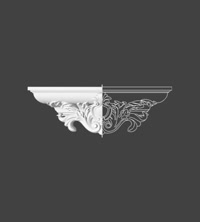
Our collection features precisely engineered models designed to meet various scale requirements. For grand vertical installations, the P08 Niche (204x517x942 mm) and the larger P09 Niche (250x680x1070 mm) serve as excellent recessed showcases for sculptures or high-end lighting fixtures. To complement these alcoves, our decorative wall appliques offer structured support and ornamentation. The substantial P507 Applique (255x520x430 mm) provides a strong architectural statement, while more compact options like the P509 (92x360x250 mm) or the P6807 (102x336x170 mm) allow for subtle, detailed accents. For balanced, mid-scale applications, the P6809 Applique (112x506x172 mm) offers a versatile profile suitable for framing mirrors, doors, or corridor transitions.
Surface Preparation and Coating Standards
Each component is delivered with a factory-applied primer (primer coat) designed to optimize surface adhesion for subsequent finishes. This factory primer prepares the surface for the application of water-based or synthetic topcoats. However, please note that paint manufacturers typically do not guarantee paint performance on surfaces coated without their specific proprietary primers. Therefore, applying an additional primer layer prior to final painting is optional and remains at the sole discretion and responsibility of the customer. Polure does not provide paint warranties or accept liability for paint performance.
Usage Areas
Our high-density decorative appliques and niches are utilized across premium European hospitality, commercial, and residential projects. In residential design, large niches such as the P09 model are integrated into entry halls (foyers), dining rooms, and salons to display fine art or sculptures under accent lighting. Appliques like the P507 or P6809 are frequently mounted symmetrically in master bedrooms to flank headboards or frame decorative wall panels. In commercial spaces, including boutique hotel lobbies, executive boardrooms, and upscale retail showrooms, these elements are paired with wall paneling to project an atmosphere of established prestige. Furthermore, due to their closed-cell structure and resistance to moisture, these products can be installed in humid wellness zones, covered patios, and exterior building facades. For exterior applications, applying a high-quality UV-resistant paint is mandatory to prevent yellowing over time, while joints must be sealed with durable exterior-grade filler.
Installation
Achieving a flawless, professional finish with our lightweight architectural components requires a systematic installation process: 1. Surface Preparation: Ensure the mounting wall surface is completely clean, dry, and level. 2. Measurement & Miter Cuts: Mark the exact placement of the niche or applique. For any custom joints, use a professional miter saw to execute precise 45-degree cuts. 3. Adhesion: Apply a high-quality polyurethane (PU) mounting adhesive to the rear contact points of the product. Do not use silicone adhesives, as they do not provide the necessary long-term structural bond. 4. Mechanical Fastening: Secure the product mechanically using screws. This mechanical fixing is mandatory to ensure safety and stability while the adhesive cures. 5. Sealing & Sanding: Fill all screw holes and joint lines using a high-quality joint filler or putty. Once dry, sand the filled areas using 180-220 grit sandpaper to achieve a smooth, flush surface. 6. Painting: Apply an optional primer coat followed by two coats of premium water-based or synthetic paint. For exterior installations, the use of a UV-resistant topcoat is mandatory.
Care Information
Maintaining the pristine appearance of our rigid polymer decorative elements is straightforward due to their non-porous, antistat-treated surfaces. For routine maintenance, dusting with a soft, dry microfiber cloth is sufficient. To remove minor smudges or dirt, wipe the surface gently with a damp cloth and a mild, non-abrasive soap solution. Because the material has a water absorption rate of less than 1%, damp cleaning will not cause swelling or warping. Avoid using harsh chemical solvents or abrasive pads, which can damage the paint finish. In the event of minor surface impacts, the material can be easily repaired by applying a small amount of fine interior putty, sanding it smooth with 180-220 grit sandpaper, and reapplying the matching topcoat.