

The Technical Evolution of Wall Panelings: moulding strip Profiles
In modern architectural design, wall paneling has transitioned from a purely decorative craft into a precise technical application. Modern polyurethane moulding strip wall moldings represent this shift, offering an engineered alternative to traditional plaster and wood decorative elements. Manufactured with a high-density structure ranging between 150-220 kg/m³, these profiles provide a wood-like hardness while remaining lightweight. This optimal density ensures high impact resistance, making them ideal for high-traffic areas where walls are prone to physical contact and abrasion.
The structural integrity of moulding strip profiles is defined by their closed-cell formulation. With a water absorption rate of under 1%, these moldings offer moisture resistance and reduce the risks of rot, mold, or fungal decay. Furthermore, they exhibit exceptional dimensional stability. Unlike wood, which expands and contracts with atmospheric changes, or plaster, which cracks under structural settling, polyurethane profiles maintain their precise geometry without warping, shrinking, or twisting over time. Their dimensional stability has been tested between -20 °C and +70 °C, ensuring zero form loss even under extreme environmental conditions.
Design Versatility: Patterned vs. Plain Profiles
The moulding strip product range is categorized into two main design directions to meet diverse architectural requirements:
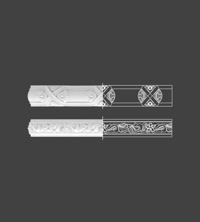
- Patterned moulding strip Profiles: Tailored for classical, neoclassical, and baroque interiors. These profiles feature highly detailed, sharp relief motifs manufactured through CNC-milled molds. Models such as the 23 mm wide P82009 or the more prominent P82052 (38x88 mm) are frequently utilized to create grand wall panels (boiserie), adding depth and historical context to modern spaces.
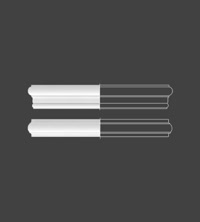
- Plain moulding strip Profiles: Designed for minimalist, contemporary, and transitionary spaces. Profiles like the P85002 model offer clean, sharp lines that serve to frame spaces, divide wall sections, or create understated geometric patterns on ceilings and walls without overwhelming the interior layout.
Material Advantages over Plaster, Wood, and EPS
When compared to historical or alternative synthetic materials, high-density polyurethane stands out across multiple performance metrics. Plaster (gypsum) moldings are notoriously fragile, heavy, and difficult to install, often requiring wet-trade coordination. Wood moldings are susceptible to pest damage, moisture swelling, and require frequent sanding and sealing. Expanded Polystyrene (EPS/foam) options lack the necessary surface hardness, leaving them vulnerable to dents and unable to capture sharp, crisp design details. Polyurethane moulding strip profiles combine the detail and hardness of wood with the lightweight, water-resistant, and non-brittle characteristics of advanced polymers, while also contributing to decorative appeal.
Surface Preparation and Coating Specifications
Every Polure moulding strip profile is delivered with a factory-applied primer (primer coat) that prepares the surface for final painting. This matte white finish is compatible with both water-based and synthetic architectural paints. However, it is critical to note the following application guidelines: while the factory primer prepares the profile surface, paint manufacturers typically do not guarantee paint adhesion or longevity unless their own proprietary primers are used beforehand. Therefore, applying an additional, brand-specific primer coat is optional and remains at the sole discretion and responsibility of the client. Polure does not provide warranties for applied paints and accepts no liability for coating failures.
Usage Areas
moulding strip wall moldings are highly versatile profiles suitable for both interior and exterior architectural applications. In residential interiors, they are primarily used to construct wainscoting, decorative wall frames, and headboard panels in bedrooms, living rooms, and corridors. In commercial spaces such as hotel lobbies, restaurants, offices, and retail showrooms, they establish a premium visual identity while protecting walls from minor impacts. For exterior facades, moulding strip profiles serve as decorative borders, window frame accents, and transitions between floor levels. When used outdoors, applying a UV-resistant exterior paint is mandatory to prevent the unpainted polyurethane material from yellowing or degrading under direct sunlight.
Installation
A successful installation of Wall Panel Trim Moldings profiles requires adherence to systematic technical steps. First, ensure the installation surface is dry, clean, and free of dust or loose particles. Map out the layout on the wall using a laser level. All joint cuts and corners must be executed at a precise 45-degree angle using a high-quality miter saw. For bonding, apply a high-strength polyurethane (PU) mounting adhesive along the rear surfaces of the profile; under no circumstances should silicone-based adhesives be used. Mechanical fixing with screws is mandatory to secure the profiles while the adhesive cures. Once fixed, cover all joint lines and screw points with a suitable exterior-grade or interior-grade putty. After the putty dries, sand the surfaces smooth using 180-220 grit sandpaper. Finally, apply a primer coat followed by two coats of water-based or synthetic paint. For exterior projects, using UV-resistant paint is mandatory.
Care Information
Maintaining polyurethane Wall Panel Trim Moldings profiles is straightforward due to their non-porous, water-resistant surface. Regular cleaning can be performed using a damp, soft cloth without the need for harsh chemical solvents or abrasive cleaners. Since the material has low water absorption (below 1%), it is less likely to swell, crack, or peel in humid environments. In the event of minor physical impacts resulting in surface dents, the affected area can be easily restored by applying standard wall putty, sanding it smooth once dry, and applying a touch-up paint coat.
Sizes and Prices
| Product code | Size (W × L × H) | Price |
|---|---|---|
| P85003 | 12 × 2400 × 16 mm | 6,28 € |
| P85002 | 14 × 2400 × 24 mm | 5,78 € |
| P82012 | 16 × 2440 × 47 mm | 10,05 € |
| P82019 | 17 × 2440 × 52 mm | 10,68 € |
| P82022 | 17 × 2440 × 56 mm | 10,05 € |
| P85008 | 20 × 2400 × 40 mm | 7,64 € |
| P85010 | 20 × 2400 × 43 mm | 7,1 € |
| P85403 | 20 × 2400 × 30 mm | 6,56 € |
| P82024 | 21 × 2440 × 59 mm | 14,75 € |
| P851350 | 21 × 2400 × 36 mm | 8,67 € |
| P85016 | 22 × 2400 × 50 mm | 7,92 € |
| P82009 | 23 × 2440 × 42 mm | 9,74 € |
| P82010 | 24 × 2418 × 40 mm | 10,21 € |
| P82017 | 24 × 2440 × 50 mm | 10,68 € |
| P82015 | 27 × 2400 × 50 mm | 10,37 € |
| P85406 | 27 × 2400 × 57 mm | 9,83 € |
| P82052 | 38 × 2440 × 88 mm | 17,9 € |
| P85015 | 40 × 2400 × 40 mm | 9,83 € |


