Project Details
| Application Area | Indoor |
|---|---|
| Style | Classic |
| Space Type | Living Room |
| Project Year | 2026 |
| Material | Rigid polyurethane (PU) |
| Density | 150-220 kg/m³ |
| Dimensional Stability Test | -20 °C / +70 °C |
| Fire Class | B2 (DIN 4102-1) |
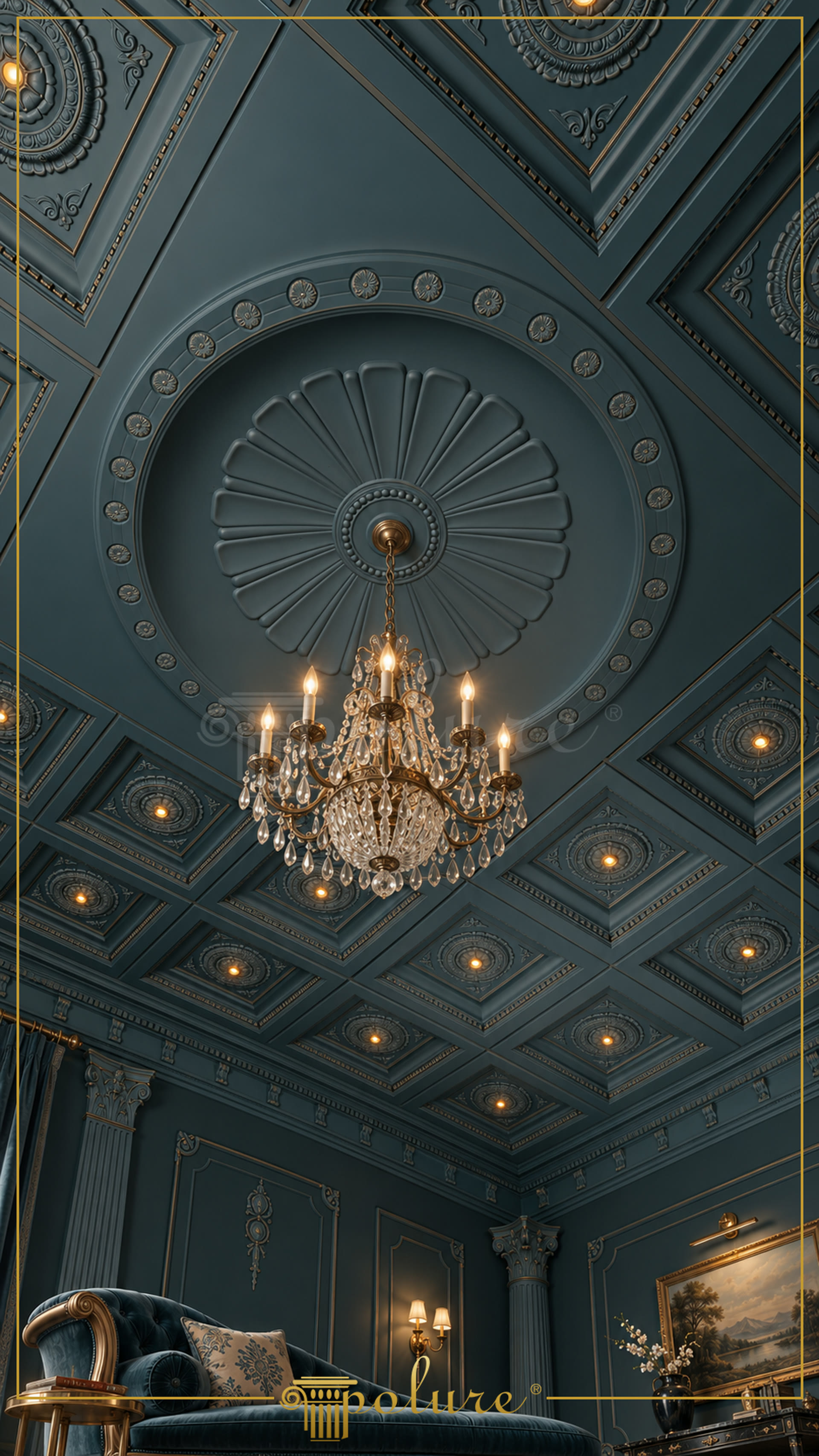
A fan-fluted poliüretan ceiling rose anchors this classic salon ceiling, its radial ribs framed by a ring of small round rosettes and a slim gilded contour line. A slender brass chain suspends the crystal chandelier from the center of the rose, positioning the fixture exactly within the medallion's radial pattern. Surrounding the medallion, square coffer panels set on a diagonal grid repeat across the entire ceiling surface, each inset with a miniature rosette and a recessed downlight at its center. A dentil-pattern cornice runs along the perimeter where ceiling meets wall, while fluted Corinthian column capitals with acanthus-leaf carving mark the vertical lines of the room, echoing the same gold-toned detailing used on the ceiling profiles.
These poliüretan ceiling rose and coffer panel systems are cast from high-density material in the 150-220 kg/m³ range, which preserves the sharp relief of the fluted medallion and the fine beading along each coffer border. The closed-cell structure keeps water absorption below 1%, supporting stable performance in heated interior spaces such as a formal salon. Dimensional behavior has been test-verified across a -20 °C / +70 °C range, relevant for installations near recessed lighting fixtures like the downlights set into each coffer. Every piece arrives factory-primed and ready to be finished in a water-based or synthetic paint, in this case a deep blue-grey tone offset by narrow gold contour lines.
Installation of the ceiling rose, coffer mouldings, and Corinthian capitals relies on a PU-based mounting adhesive, reinforced with mechanical fixings on the wider cornice and capital sections; silicone adhesives are not used for this type of fixing. Because the material is considerably lighter than comparable plaster or stone elements, the ceiling rose and individual coffer frames can typically be positioned and fixed by a single installer, which simplifies work on a ceiling of this scale. Each coffer panel, cornice run, and capital profile is produced to order for the specific room dimensions, so the diagonal coffer grid and the ring of rosettes around the medallion can be adapted to a different ceiling size without altering the proportions shown here.
This combination of a radial ceiling rose, diamond coffer grid, dentil cornice, and fluted Corinthian capitals suits classic and neoclassical salons where a chandelier or multi-arm fixture is meant to read as the room's focal point. The same gold-line detailing carried from the medallion through the coffers and down to the wall paneling keeps the ceiling and wall treatments visually connected in a single interior. Custom profiles of this kind are produced from molds built for each project using 3D scanning and CNC-based model preparation, which allows the coffer dimensions and rosette spacing to be matched precisely to an existing room before production begins. The same custom-mold approach extends to the Corinthian capitals and the dentil cornice, so a full ceiling and wall ensemble like this one can be reproduced from scan data rather than from stock dimensions alone.
The diagonal orientation of the square coffers, rather than a grid aligned with the walls, gives the ceiling a more dynamic rhythm than a standard square coffer layout. Recessed downlights are placed inside selected coffers rather than at every intersection, which keeps the lighting plan secondary to the chandelier at the center. The ring of small rosettes framing the ceiling rose repeats the same circular motif used inside the medallion, tying the two scales of ornament together. Corinthian capitals on the fluted columns introduce carved acanthus-leaf detail that contrasts with the flatter, line-based ornament on the ceiling panels. A matching dentil-pattern cornice runs where the ceiling meets the wall, giving the coffer grid a defined edge rather than letting it run to the wall line. The deep blue-grey base color combined with narrow gold contour lines along every profile edge keeps the dense ornamentation legible without raising the overall contrast of the room. Wall paneling below the cornice continues the same framed-panel logic as the ceiling coffers, carrying the geometry down to eye level.


