

Architectural Definition and Purpose of Decorative Border Moldings Profiles
In high-end interior architecture and facade design, dividing wall surfaces horizontally or vertically is a fundamental technique to balance proportions. Decorative Decorative Border Moldings profiles act as structural framing elements that segment spaces, define transitions between different materials (such as wallpaper and paint), and add physical depth to flat planes. These rigid polymer profiles offer an advanced alternative to traditional plaster or wood moldings, combining structural strength with lightweight efficiency.
Engineered with a density of 150-220 kg/m³, these profiles match the hardness of softwoods while remaining significantly lighter. This optimal density ensures they do not place unnecessary structural loads on walls or ceilings, making them a preferred choice for large-scale commercial renovations and historical restorations across Europe.
Design Versatility: Plain and Patterned Collections
To accommodate diverse architectural styles from minimalist Scandinavian designs to classical Baroque interiors, the collection is divided into two distinct design categories:
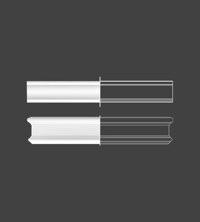
- Plain Models: Featuring clean lines and geometric simplicity, profiles like P2001 (27x2400x123 mm) and P2002 (37x2400x150 mm) are designed for modern spaces. They integrate seamlessly with flat walls, catching natural light without overwhelming the room's visual scheme.
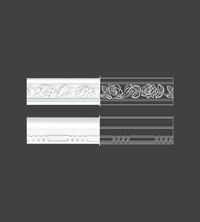
- Patterned Models: For projects requiring classical ornamentation, models such as P2001A (34x2160x123 mm), P2001B (44x2190x123 mm), and P2002B (65x2400x150 mm) feature detailed floral motifs and symmetrical reliefs. Combined with corner elements like P2001K (460x460x55 mm) and P2002K (560x560x55 mm), they form elaborate wall frames without requiring complex manual carving.
Material Engineering and Performance Benefits
The closed-cell structure of the rigid polymer material provides exceptional resistance to environmental factors. With a water absorption rate under 1%, these profiles are highly resistant to rot, swelling, and moisture damage. This makes them highly stable compared to wood, which warps under high humidity, and plaster, which is prone to cracking and shattering upon impact.
Additionally, the material exhibits high dimensional stability, meaning it will not shrink or expand significantly under temperature fluctuations ranging from -20 °C / +70 °C. This thermal resilience prevents unsightly joint separation over time. The material has fire class B2 (DIN 4102-1).
Surface Preparation and Coating Guidelines
Each profile is shipped with a factory-applied primer that optimizes surface preparation for subsequent coatings. This base layer accepts both water-based and synthetic paints. However, to ensure long-term paint adhesion and maintain manufacturer warranties, applying an additional primer compatible with your chosen paint brand is recommended before the final coats. Since paint manufacturers do not guarantee adhesion on unprimed surfaces, this optional step is left to the installer's discretion. For exterior applications, the use of UV-resistant paint is mandatory, as unpainted polymer surfaces may experience yellowing when exposed to direct sunlight.
Usage Areas
These architectural Decorative Border Moldings profiles are highly versatile, serving both interior and exterior decoration purposes. Indoors, they are commonly utilized as dado rails to divide walls into distinct color schemes, frame wallpaper panels, or outline ceiling borders in living rooms, master bedrooms, and hotel lobbies. They are also ideal for wet areas like bathrooms and kitchens due to their moisture-resistant properties. Externally, they function as decorative belt courses, window surrounds, or facade divisions, adding architectural depth to residential villas and commercial buildings when finished with UV-stable coatings.
Installation
Successful installation requires a clean, completely dry, and level substrate. Begin by making precise 45-degree miter cuts using a fine-toothed saw. Apply a continuous bead of polyurethane (PU) mounting adhesive along the rear mounting surfaces of the profile; do not use silicone-based adhesives. Press the profile firmly against the wall and secure it mechanically using screws—this mechanical fixing is mandatory to prevent shifting during the curing process. Once the adhesive has dried, fill all screw holes and joint gaps with a suitable joint filler or exterior putty. Gently sand these areas using 180-220 grit sandpaper to achieve a seamless surface. Finally, apply an optional primer coat followed by two coats of high-quality paint.
Care Information
Maintenance of these high-density polymer profiles is straightforward. For regular dust removal, use a soft, damp microfiber cloth. Avoid using harsh chemical solvents, high-acid cleaners, or abrasive brushes, as these can degrade the paint finish. If the surface becomes scuffed or damaged over time, it can be easily repaired by applying a light coat of wall putty, sanding with a fine paper, and spot-painting with the matching wall color.
Sizes and Prices
| Product code | Size (W × L × H) | Price |
|---|---|---|
| P82060 | 17 × 2440 × 100 mm | 23,21 € |
| P82083 | 17 × 2440 × 127 mm | 23,89 € |
| P82084 | 19 × 2440 × 128 mm | 24,57 € |
| P82047 | 20 × 2440 × 85 mm | 21,5 € |
| P82062 | 20 × 2440 × 81 mm | 22,52 € |
| P85409 | 22 × 2400 × 95 mm | 23,96 € |
| P82072 | 23 × 2440 × 110 mm | 23,21 € |
| P82076 | 23 × 2440 × 113 mm | 23,21 € |
| P85036 | 23 × 2400 × 82 mm | 12,34 € |
| 2PBOR60 | 25 × 2400 × 60 mm | 25,87 € |
| P2001 | 27 × 2400 × 123 mm | 32,42 € |
| P85025 | 28 × 2400 × 62 mm | 11,15 € |
| P85408 | 28 × 2400 × 97 mm | 23,96 € |
| P2001A | 34 × 2160 × 123 mm | 52,9 € |
| P2001C | 34 × 2180 × 123 mm | 52,9 € |
| P82058 | 35 × 2430 × 94 mm | 27,3 € |
| P85407 | 35 × 2400 × 87 mm | 15,14 € |
| P2002 | 37 × 2400 × 150 mm | 39,25 € |
| P85024M | 40 × 2400 × 100 mm | 18,77 € |
| P2001B | 44 × 2190 × 123 mm | 52,9 € |
| P2002A | 52 × 2160 × 185 mm | 56,31 € |
| P2002C | 53 × 2400 × 150 mm | 56,31 € |
| P2002B | 65 × 2400 × 150 mm | 56,31 € |
| P2001K | 460 × 460 × 55 mm | 29,69 € |
| P2002K | 560 × 560 × 55 mm | 33,11 € |