
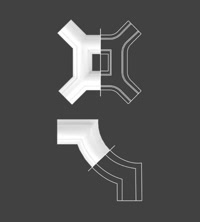


Introduction to High-Density Wall Framing Systems
In modern European interior design and historical renovation projects, achieving clean, crisp joints in wall paneling is paramount. The panel molding corner serves as the primary structural and decorative component designed to eliminate complicated miter joint alignments on-site. Manufactured from high-density rigid polyurethane (PU) with a closed-cell structure, these corner elements offer an engineered alternative to traditional plaster or timber. With a density profile of 150-220 kg/m³, they provide a wood-like hardness while remaining remarkably lightweight and structurally stable. This prevents the common issues of joint parting, cracking, or moisture-induced rot that frequently affect timber moldings.
Technical Profile & Material Performance
The technical superiority of the panel molding corner lies in its precise chemical formulation. Unlike low-density EPS or brittle plaster, our rigid PU material exhibits outstanding physical resilience:
- Density: 150-220 kg/m³, providing high impact resistance without adding unnecessary dead load to the building structure.
- Dimensional Stability Test: Dimensional stability has been tested between -20 °C and +70 °C with zero thermal expansion or form loss.
- Moisture Resistance: Water absorption is rated under 1% due to the closed-cell polymer structure, making them highly resistant to rot.
- Fire Behavior: The material has fire class B2 (DIN 4102-1).
Architectural Styles and Dimensional Diversity
Our product range accommodates both classic ornamental compositions and minimalist modern geometries. For historical restorations, baroque, or neoclassical motifs, models such as the P82009A (300x300x30 mm) feature detailed acanthus leaves and delicate relief work that elevate standard wall framing. Projects requiring grand scale can utilize the P82024A (710x710x37 mm) for high-ceilinged hotel lobbies or stately residential salons. For asymmetrical and dynamic wall layouts, the P82017A (348x257x27 mm) offers a sophisticated fluid curve that breaks away from conventional rectangular frames.
Conversely, contemporary interiors benefit from streamlined geometries like the P82010F (190x190x24 mm), which delivers clean, perpendicular transitions for modest panel sizes. Highly versatile models like the P82015A and P82015C (245x245x30 mm) function seamlessly across both wall and ceiling borders, allowing architects to maintain visual continuity throughout the interior envelope. For deeper, more dramatic shadow lines, the P82052B (410x410x38 mm) provides a robust profile depth that interacts beautifully with integrated LED cove lighting schemes.
The Importance of Surface Preparation and Coating
All panel molding corner profiles are delivered from the factory pre-treated with a matte white primer. This factory-applied primer is engineered to optimize the surface energy of the rigid PU, ensuring uniform adhesion of subsequent paint coats. However, professionals must note the industry-standard coating guidelines: while the factory primer prepares the surface for painting, paint manufacturers do not guarantee paint adhesion on pre-primed surfaces unless their own specific primers are applied. Therefore, the application of an additional on-site primer is optional and remains at the sole discretion and responsibility of the installer. Polure does not warrant or accept liability for the performance of third-party paints applied to our products.
For interior applications, water-based or synthetic paints can be applied in two coats. For any outdoor integration, it is mandatory to apply a high-quality UV-resistant exterior paint to prevent yellowing or degradation of the underlying PU substrate over time. To ensure a flawless finish, we recommend integrating polyurethane panel molding corner profiles with matching linear trim to create cohesive wall corner molding systems.
Structural Superiority Over Traditional Materials
When specifying materials for large-scale commercial developments, architects must weigh the lifecycle costs and installation speeds of plaster, wood, and MDF against modern polymers. Plaster, while historically authentic, is exceptionally heavy, prone to fracturing during transit or building settlement, and highly labor-intensive to install. Timber and MDF alternatives are susceptible to environmental humidity, leading to warping, swelling, and joint separation over time. In contrast, our panel molding corner elements bypass these material limitations. The 150-220 kg/m³ density ensures that the decorative surface can withstand the impact of vacuums, furniture, and daily human contact. Additionally, the pre-molded precision of each piece means that installers do not need to spend hours hand-carving or sanding complex corner joints on-site. This decreases total installation time by up to 70%, translating directly into reduced labor costs and faster project handover times.
Integrating the Panel Molding Corner in Modern Architectural Layouts
To maximize the visual impact of a paneling project, designers often implement the wainscoting technique on the lower third of walls, using a decorative corner border or panel corner element to define the transitions. By combining these corner pieces with linear profiles, you can create balanced proportions that alter the perceived height and width of a room. For instance, vertical rectangular frames topped with dynamic corner elements draw the eye upward, making low ceilings appear higher. In contrast, horizontal framing configurations can make narrow corridors feel more spacious. Because these elements can be easily filled, sanded, and painted, they integrate flawlessly into the drywall, creating a monolithic, built-in appearance that looks like custom plasterwork but performs with the durability of advanced polymer engineering.
Usage Areas
The panel molding corner profiles are highly versatile architectural elements utilized in both residential and high-end commercial spaces. Indoors, they are commonly specified for formal dining rooms, grand living rooms, and master bedroom suites to construct sophisticated wainscoting and wall frames. They are particularly effective when placed behind bed headboards, along hallway walls, or around large wall-mounted mirrors to act as a decorative corner border or panel corner element. In commercial environments such as boutique hotels, fine dining establishments, and corporate boardrooms, these corner elements establish a sense of structure and prestige. Due to their closed-cell structure and exceptional moisture resistance, they are also perfectly suited for damp environments, including luxury bathrooms, spa reception areas, and kitchen accent walls, where traditional MDF or wood would quickly warp or rot. For exterior facades, they can be utilized as decorative corners for window surrounds, entryway pediments, or under-eave detailing. When used outdoors, they must be coated with a high-quality UV-resistant paint to protect the polyurethane substrate from solar exposure and prevent yellowing. Additionally, these profiles are frequently used in ceiling designs to complement elaborate gypsum or PU cornices, creating multi-layered ceiling medallions and geometric frames.
Installation
Installing the Panel Molding Corner Joints profiles requires a systematic approach to ensure long-lasting structural integrity: 1. Preparation: Ensure the application surface is completely clean, dry, and free of dust, grease, or loose plaster. 2. Alignment: Mark the exact layout of your wall or ceiling frame using a laser level. Dry-fit the corners and linear profiles to confirm alignment. 3. Cutting: Perform precise 45-degree miter cuts on the connecting linear profiles to match the receiving ends of the corner pieces. 4. Adhesion: Apply a generous bead of polyurethane (PU) mounting adhesive to the rear mounting channels of the corner piece. Do not use silicone adhesives, as they do not provide the necessary long-term bond strength. 5. Mechanical Fixing: Press the corner firmly onto the wall. For safety and structural stability, mechanical fixing with screws or brad nails is mandatory. 6. Finishing: Fill any screw holes and joint seams with a high-quality interior or exterior putty. Once dry, sand the joint areas smooth using 180-220 grit sandpaper. 7. Painting: Wipe away all sanding dust. Apply an optional primer coat if required by your paint manufacturer, followed by two coats of water-based or synthetic paint. For exterior installations, a UV-resistant topcoat is mandatory to prevent material yellowing.
Care Information
Maintaining rigid PU Panel Molding Corner Joints profiles is incredibly straightforward due to the material's high density and water-resistant properties. For regular maintenance, simply wipe the surfaces with a soft, slightly damp microfiber cloth to remove accumulated dust. For detailed ornamental patterns, a soft-bristled brush or a vacuum cleaner with a delicate brush attachment can be used to safely clear dust from intricate reliefs. Never use harsh chemical solvents, acetone, or paint thinners, as these substances can dissolve the protective paint layer or damage the underlying polymer substrate. Under normal indoor conditions, these profiles retain their structural integrity, shape, and crisp detailing, with performance depending on the paint system and exposure. They represent a highly durable, virtually maintenance-free architectural solution that stands up to the rigors of daily wear and tear in both residential and high-traffic commercial environments.
Sizes and Prices
| Product code | Size (W × L × H) | Price |
|---|---|---|
| P85008D | 110 × 248 × 24 mm | 5,42 € |
| P85002A | 111 × 111 × 15 mm | 5,15 € |
| P85002D8 | 128 × 128 × 14 mm | 6,47 € |
| P85008B | 133 × 133 × 20 mm | 4,58 € |
| P85002C | 160 × 160 × 27 mm | 4,85 € |
| P85008C | 170 × 170 × 32 mm | 5,42 € |
| P85002M | 183 × 183 × 14 mm | 4,85 € |
| P85002S | 184 × 184 × 18 mm | 4,46 € |
| P82010F | 190 × 190 × 24 mm | 4,58 € |
| P85002B | 195 × 195 × 22 mm | 5,42 € |
| P85002D15 | 198 × 198 × 14 mm | 9,72 € |
| P85002D | 200 × 200 × 22 mm | 5,15 € |
| P85002F | 200 × 200 × 15 mm | 6,56 € |
| P85008A | 200 × 200 × 20 mm | 5,15 € |
| P82010B | 224 × 224 × 24 mm | 5,7 € |
| P82015A | 240 × 240 × 30 mm | 5,7 € |
| P82015C | 245 × 245 × 30 mm | 7,43 € |
| P85010B | 250 × 250 × 32 mm | 7,43 € |
| P85016C | 255 × 255 × 22 mm | 5,15 € |
| P85008S | 270 × 270 × 34 mm | 7,43 € |
| P85008G | 275 × 275 × 29 mm | 7,43 € |
| P82012A | 280 × 280 × 30 mm | 8,27 € |
| P82019A | 280 × 280 × 24 mm | 9,42 € |
| P85002E | 280 × 280 × 21 mm | 9,14 € |
| P85002W | 285 × 923 × 34 mm | 34,25 € |
| P85016D | 288 × 288 × 35 mm | 7,43 € |
| P82009A | 300 × 300 × 30 mm | 7,72 € |
| P85008F | 305 × 305 × 26 mm | 7,72 € |
| P85016T | 330 × 330 × 38 mm | 6,86 € |
| P85002L | 332 × 210 × 20 mm | 7,43 € |
| P85002R | 332 × 210 × 20 mm | 7,43 € |
| P85010L | 340 × 340 × 27 mm | 8,42 € |
| P85010R | 340 × 340 × 27 mm | 8,42 € |
| P82017A | 348 × 257 × 27 mm | 9,14 € |
| P85016B | 380 × 380 × 38 mm | 8,27 € |
| P85002WL | 385 × 248 × 18 mm | 7,72 € |
| P85002WR | 385 × 248 × 18 mm | 7,72 € |
| P85016A | 407 × 407 × 40 mm | 10,28 € |
| P82052B | 410 × 410 × 38 mm | 22,84 € |
| P85016L | 510 × 300 × 40 mm | 15,41 € |
| P85016R | 510 × 300 × 40 mm | 15,41 € |
| P85010C | 675 × 290 × 43 mm | 22,26 € |
| P82024A | 710 × 710 × 37 mm | 31,4 € |