


High-Performance Polymer Decorative Wall Panels Collection for Architectural Environments
In modern European architecture, creating depth and structural character on flat surfaces requires materials that combine technical precision with design flexibility. High-density rigid polyurethane (PU) decorative wall panels have emerged as the leading alternative to heavy traditional plasterwork and high-maintenance timber. Engineered with a closed-cell structure and a density of 150-220 kg/m³, these elements deliver wood-like surface hardness while remaining exceptionally lightweight. This technical specification ensures easy handling on-site while being lightweight and putting only a limited load on the building. With dimensional stability tested between -20 °C and +70 °C, these architectural elements maintain their shape, resisting warping, shrinkage, or thermal expansion in both interior and exterior applications.
Decupe and Fretwork Designs: Controlling Light and Space
Perforated or decupe panels serve as functional design elements that manage light transmission and spatial separation. Within the Polure range, models like the 2P8143A33 and 2P8143A90 offer complex geometric patterns and precise cuts. These products are frequently specified by European architects for:
- Decorative space dividers and partition walls in commercial offices and hospitality venues.
- Suspended ceiling systems integrated with indirect LED lighting to generate structured shadow patterns.
- Zonal screening that maintains airflow and visual continuity while defining distinct functional areas.
Three-Dimensional Relief Panels: Classical Influences
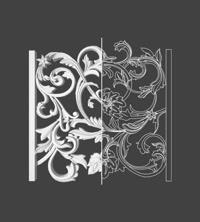
For walls requiring strong tactile depth, relief panels recreate historical ornamentation with modern material benefits. The P1037 model, measuring 905x905x43 mm, features a square format with symmetrical, high-relief motifs designed to establish a clear focal point. Similarly, the P1453A model brings classical palace ornamentation to high-end residential interiors. Beyond aesthetics, the textured surfaces of these panels contribute to the acoustic performance of a room by breaking up flat reflective planes and reducing echo. The high-density formulation ensures that every fine scroll, leaf, and line is rendered with sharp resolution, providing a premium finish that stands up to close inspection.
Modern Linear Decorative Wall Panels Collection: Minimalist and Commercial Applications
Contemporary projects often demand clean lines, repeating textures, and industrial simplicity. The P180120BU (measuring 243x2400x17 mm) and the P3000 series (including the P3000B) cater to this minimalist aesthetic. These linear panels are ideal for covering large surface areas quickly, providing a structured backdrop in hotel lobbies, high-traffic corridors, and corporate boardrooms. The P3000B panel features a refined texture that responds well to strategic uplighting. Unlike natural timber cladding, these panels do not warp, split, or rot when exposed to humidity, making them fully suitable for high-moisture interiors such as luxury bathrooms and spa reception areas.
Comparative Material Advantages
When selecting wall cladding systems, comparing our polymer products to traditional materials highlights several key performance advantages:
- Over Gypsum (Plaster): Our material is highly impact-resistant and shatterproof. It reduces installation times significantly because it does not require wet-trade processes or extensive drying periods.
- Over Natural Timber: With water absorption below 1%, these products are immune to rot, wood-boring insects, and moisture-induced dimensional movement.
- Over EPS (Expanded Polystyrene): EPS foam lacks the surface hardness and detail sharpness required for premium architectural finishes. Polure panels provide a crisp, sandable, and durable surface that handles physical impacts.
Usage Areas
Polure decorative wall panels are highly versatile, serving both interior and exterior architectural schemes. In residential interiors, they are commonly applied to create feature walls behind bed headboards, structure plain hallways, or frame chimney breasts. In commercial spaces like luxury hotels, restaurants, and corporate offices, these panels define reception desks, conference room walls, and acoustic partitions. Their moisture-resistant, closed-cell structure enables safe installation in high-humidity zones such as bathrooms, kitchen backsplashes, and indoor pool lounges. For exterior facades, they are utilized as decorative under-eaves cladding, entrance portals, or ornamental window surrounds. When used outdoors, the panels must be coated with UV-stable exterior paints to ensure long-term color and material stability.
Installation
Successful installation of high-density PU decorative wall panels requires a systematic approach. The application surface must be completely clean, dry, and structurally sound. Panels should be measured carefully and cut using a miter saw at a 45-degree angle for seamless corner joints. For mounting, apply a high-quality polyurethane (PU) mounting adhesive in continuous beads along the back edges of the panel; do not use standard silicone adhesives. Mechanical fastening with screws is mandatory to secure the panels in place while the adhesive cures. Once fixed, all joint lines and screw holes must be filled using a high-grade filler (or exterior-grade putty for outdoor applications). After curing, sand the filled areas smooth using 180-220 grit sandpaper. Finally, apply a suitable paint system (water-based or synthetic). Note that while the factory primer prepares the surface, applying an additional primer is optional and at the customer's discretion; paint manufacturers may require their own primers to validate paint warranties.
Care Information
Maintaining PU decorative wall panels is highly straightforward due to their non-porous, closed-cell structure. Regular dust removal can be completed using a soft dry cloth or a microfibre duster. For deeper cleaning or to remove light scuffs, use a damp cloth with a mild, non-abrasive detergent solution. Avoid using harsh chemical solvents or abrasive scrubbing pads, which could damage the painted finish. Because the material has low water absorption (below 1%), it will not warp or swell during cleaning. If the room's color scheme changes in the future, the panels can be easily sanded lightly and repainted with two coats of any standard interior or exterior paint.
Sizes and Prices
| Product code | Size (W × L × H) | Price |
|---|---|---|
| P3004 | 85 × 2880 × 695 mm | 303,81 € |
| P3004A | 85 × 1440 × 695 mm | 134,03 € |
| P3004B | 85 × 1440 × 685 mm | 134,03 € |
| P85003BU | 154 × 2400 × 19 mm | 42,82 € |
| P85050BU | 194 × 2400 × 15 mm | 35,57 € |
| P82210 | 240 × 2100 × 35 mm | 86,87 € |
| P180120BU | 243 × 2400 × 17 mm | 43,6 € |
| P9135 | 270 × 1820 × 37 mm | 60,2 € |
| P9135B | 270 × 2400 × 26 mm | 58,96 € |
| P3002 | 300 × 950 × 30 mm | 25,76 € |
| P85067BU | 302 × 2400 × 20 mm | 53,92 € |
| P851350BU | 334 × 2400 × 29 mm | 63,83 € |
| P8107 | 360 × 1056 × 32 mm | 30,41 € |
| P8105 | 380 × 800 × 32 mm | 28,54 € |
| P9113A | 400 × 780 × 78 mm | 107,36 € |
| P3040A | 449 × 2400 × 30 mm | 69,8 € |
| P3040 | 450 × 2500 × 30 mm | 69,8 € |
| P8110RL | 497 × 993 × 45 mm | 27,93 € |
| P3000B | 500 × 1010 × 20 mm | 25,13 € |
| P3000C | 537 × 995 × 30 mm | 69,8 € |
| P8142 | 570 × 570 × 36 mm | 30,41 € |
| P36060 | 600 × 600 × 12 mm | 13,52 € |
| P3001 | 605 × 1350 × 24 mm | 54,29 € |
| P1985 | 615 × 255 × 31 mm | 49,33 € |
| P8141 | 623 × 623 × 25 mm | 35,05 € |
| P3000 | 630 × 2880 × 20 mm | 89,99 € |
| P7403 | 630 × 630 × 30 mm | 29,48 € |
| P3003 | 652 × 1248 × 33 mm | 77,83 € |
| P3000D4 | 700 × 1440 × 40 mm | 63,83 € |
| P8109 | 705 × 1000 × 30 mm | 121,01 € |
| P3000D10 | 720 × 1460 × 100 mm | 159,56 € |
| P3000D15 | 720 × 1460 × 150 mm | 239,37 € |
| P3000D6 | 720 × 1460 × 60 mm | 95,74 € |
| P3000D8 | 720 × 1460 × 80 mm | 127,68 € |
| P1453A | 820 × 730 × 14 mm | 178,4 € |
| P1037 | 905 × 905 × 43 mm | 201,66 € |
| P3000A | 970 × 2880 × 20 mm | 133,41 € |
| P8110 | 1000 × 993 × 67 mm | 189,26 € |
| P1453 | 1050 × 960 × 50 mm | 210,98 € |
| P312020 | 1200 × 200 × 18 mm | 13,07 € |
| P8110A | 1420 × 993 × 67 mm | 217,16 € |
| P9140 | 1600 × 400 × 47 mm | 130,31 € |


